From Programmatic to Agentic: The Next Era of Advertising for HK Marketers
If you're a digital marketer in Hong Kong, you already know that automation isn't new. For over a decade, programmatic media buying has allowed us to purchase ad inventory at scale, using algorithms instead of insertion orders.
But as we move through 2026, a fundamental shift is happening in ad-tech. We are gradually moving away from programmatic automation and entering the era of agentic autonomy.
This isn't just an upgrade to Performance Max or Advantage+. It is a complete rewiring of how media is bought, sold, and optimized. Whether you're managing budgets for a local HK retailer or a multinational brand, here is what you need to know about the shift from script-following to goal-seeking AI.
The Core Shift: From Script-Following to Goal-Seeking
To understand agentic media buying, you have to understand its predecessor.
Programmatic buying operates like a thermostat. It relies on deterministic, "if/then" logic. A human media buyer must build the campaign architecture, define the audience segments, load the creative, and set strict rules (e.g., "If CPC exceeds $15 HKD, lower the bid"). The system flawlessly executes that exact script, but it cannot reason beyond those instructions.
Agentic buying operates like an autonomous operator. Instead of configuring rigid rules, a marketer provides the AI agent with a high-level goal, such as "Acquire new software subscriptions at a target CPA of $400 HKD." Operating on a continuous "perceive-reason-act" loop, the AI agent reads the objective, evaluates the market, structures the ad groups, and shifts budget across entirely different platforms minute-by-minute based on live performance signals.
📊 Key Differences at a Glance
| 🎯 Feature | ⚙️ Programmatic Buying (The Existing Way) | 🤖 Agentic Buying (The New Way) |
| Core Logic | Rule-based & Deterministic: Follows strict "if/then" logic. | Goal-oriented & Adaptive: Uses a continuous "perceive-reason-act" loop. |
| Human Role | The Orchestrator: Manually sets rules, loads ads, and allocates budget. | The Director: Provides context, sets the overarching goal, budget limits, and brand guardrails. |
| Decision Making | Blind Execution: Flawlessly executes human-defined scripts at massive scale. | Autonomous Action: Perceives live data, reasons through complex plans, and acts. |
| Optimization Pace | Periodic: Usually optimized in daily or weekly cycles requiring human intervention. | Real-Time: Adjusts spend and strategy minute-by-minute based on live signals. |
| Creative Process | Static Management: Relies on humans to supply, A/B test, and update assets. | Dynamic Generation: Generates, tests, and iterates customized creative on the fly. |
| Platform Scope | Siloed: Typically optimizes within a single platform's walled ecosystem. | Cross-Channel: Reasons and shifts budget across multiple platforms simultaneously. |
The New Agentic Ecosystem
If AI agents are going to spend millions autonomously, they need a standardized "city grid" to operate within. Without getting bogged down in ad-tech engineering, here are the four pillars making this possible:
- AAMP (The Framework): This is the IAB Tech Lab’s umbrella initiative for developing agentic advertising standards. It extends programmatic real-time bidding infrastructure for AI agents and includes foundational layers for trust, transparency, and privacy.
- AdCP (The Language): This is an open standard governed by AgenticAdvertising.org. It defines the campaign-layer language, allowing buyer and seller agents to discover each other, negotiate terms, and transact across the ecosystem.
- MCP (The Universal Plug): Developed by Anthropic, the Model Context Protocol is integrated into these frameworks to securely connect AI agents to external tools and systems.
- A2A (The Handshake): "Agent-to-Agent" describes the transaction model where the buying AI and selling AI negotiate terms and close the deal autonomously in milliseconds.
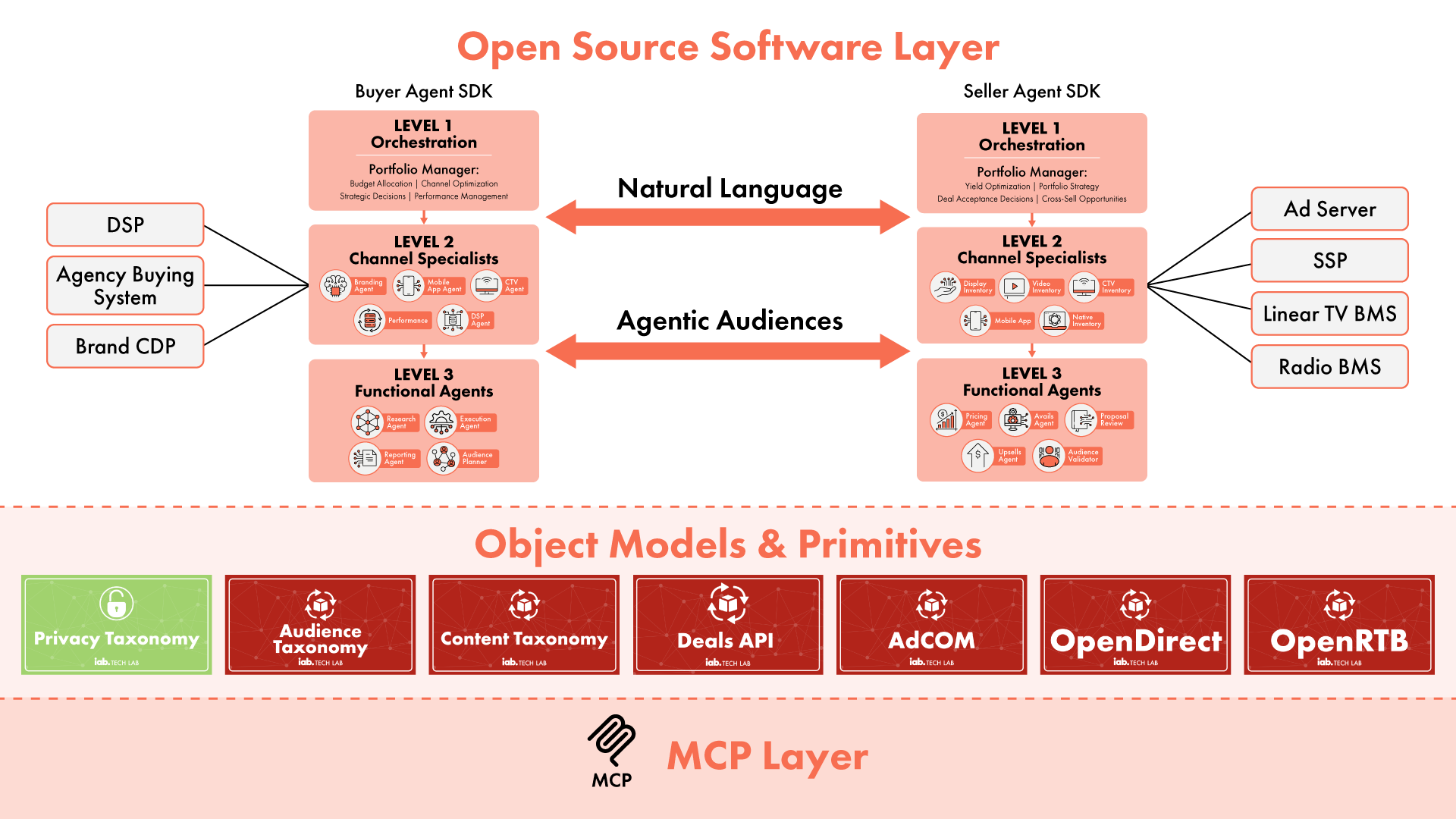
How agentic AI bridges the old and new: Existing ad tech (DSPs, SSPs, CDPs) feeds into Agent SDKs, which communicate via natural language, with MCP sitting as the foundational protocol at the bottom.
How It Actually Works: An FMCG Scenario
To understand how these protocols function, imagine you are the digital marketing lead for a major FMCG brand launching a new zero-sugar sports drink in Hong Kong. Your goal is to drive foot traffic to local convenience stores over a hot summer weekend, with a target Cost-Per-Store-Visit of $15 HKD.
Here is how agentic media buying executes that goal without manual intervention:
Step 1: Your AI drafts the Brief (via AdCP)
As the human director, you input your budget, footfall target, approved video creatives, and geographic constraints (targeting within a 500-meter radius of stockists). Your AI takes these instructions and translates them into a standardized format using AdCP. It broadcasts your intent: "I need to reach health-conscious commuters in Hong Kong Island and Kowloon this weekend, driving them to local convenience stores, at a max CPA of $15 HKD."
Step 2: Publishers broadcast their Menu (via MCP)
Meanwhile, local publishers—like the MTR mobile app, a popular HK fitness influencer network, and a local weather app—have set up MCP servers. Instead of an ad ops team emailing available impressions, the weather app’s MCP server broadcasts: "It is 32°C in Causeway Bay right now. I have 10,000 active users checking the app within 200 meters of a 7-Eleven, and here is the context and pricing for high-impact video."
Step 3: The A2A (Agent-to-Agent) Negotiation
Your buying AI instantly reads the MCP menus of these local platforms. Spotting the hyper-relevant context on the weather app (hot weather + proximity to the store), it initiates an A2A transaction.
The two AIs negotiate the terms, verify each other's credentials (ensuring compliance under the IAB's AAMP framework or an AdCP environment), and execute the video ad buy in milliseconds. There is no human adjusting bids based on the weather, and no manual pausing of campaigns when it rains. The AIs handle the dynamic execution, while you focus on the overarching brand strategy..
What This Means for Hong Kong Marketers
The shift toward agentic AI is not about replacing traditional advertising overnight; it is about augmenting human capability. As AI handles manual execution, testing, and real-time bid adjustments, marketers transition from "button pushers" to "strategic orchestrators". For Hong Kong brands, this also unlocks unprecedented scale across the APAC region, making it seamless to test, adapt, and localize campaigns across different markets.
📋 Marketer Action Plan: 4 Immediate Next Steps
1. Clean and Structure Your First-Party Data: An AI agent is only as intelligent as the data feeding it. Ensure your CRM, conversion tracking, and event pixels are accurate, structured, and compliant with privacy frameworks.
2. Set Strict Guardrails & Deep Context: Establish clear boundaries (max budgets, CPA targets, and brand safety limits). Crucially, you must also feed the AI deep background information—like profit margins and brand guidelines. Providing this broader context allows the agent to exercise better judgment and make smarter, controlled optimization decisions.
3. Start Small with "Human-in-the-Loop" Pilots: Begin experimenting with AI tools for low-risk tasks—such as creative variant generation, copy testing, or data analysis—while keeping a human firmly in place for final approvals.
4. Shift Team Focus Upstream: Train your team to focus on goal setting, prompt drafting, and interpreting high-level market insights rather than manual campaign setup and daily bid tweaks.
Contributed by IAB Hong Kong - Programmatic & Measurement Committee Members: | ||
 |  |  |
Jo Liu Associate Director, Digital Advertising Operations, South Morning China Post | Jonathan Chan Head of Sales, HK, Teads | Noelle Wong Digital Director, Zenith |
Article launched on 16/11/2026 | ||
