Author: Jossie Liu, Lead Associate Account Director, The Trade Desk IAB Hong Kong - Programmatic & Measurement Committee Member
In Hong Kong, advertising doesn’t compete for space—it competes for attention in motion. A single consumer moves through dozens of content environments in a day, switching from mobile to TV to outdoor and back again, often within seconds. In that flow, most ads are not rejected—they are simply forgotten.
This is what makes conversion difficult to define—and even harder to optimize.
Adding to this complexity, most marketers are not choosing to focus on the last touchpoint—they are often expected to. As marketing impact comes under increasing scrutiny from leadership, conversion metrics become the most defensible way to demonstrate value. This article recognizes that constraint. Rather than challenging the importance of conversion, it revisits how conversion is defined and interpreted today.
In Section 1, we debunk a few common misconceptions that shape how performance is evaluated—and why these assumptions persist. In Section 2, we outline a set of practical considerations that marketers can apply in their next campaign to better reflect how consumers actually decide. Finally, we bring these principles to life through a real-world case study, demonstrating how a leading global CPG brand in Hong Kong translated journey-based thinking into measurable business outcomes.
Rethinking conversion in this way is not just a theoretical shift. It directly shapes how budgets are allocated, how campaigns are designed, and ultimately, whether brands are building enduring relevance—or simply capturing what is already there.
Most marketing teams aren’t short on effort — they’re short on permission to invest. In many organizations, marketing is still asked to justify spend like a revenue function, while being measured with tools that only capture the final moment. That’s why “conversion” becomes a stressful word: it feels objective, but it’s often incomplete.
To make conversion useful — for optimization and for explaining value to leadership — we need to challenge a few myths that quietly shape how budgets are decided.
Myth 1: “Conversion is a universal metric”
One of the most overlooked realities in marketing is that “conversion” is not a fixed definition. It is context-dependent, shaped by campaign objectives, business priorities, and consumer behavior.
Even within the same brand, conversion definitions can vary significantly:
A new product launch (NPL) may define conversion as incremental sales, trial, or store visits.
A promotion-led campaign may define conversion as coupon redemption or add-to-cart.
Always-on brand activity may focus on qualified reach, consideration lift, or sustained sales over time.
Reality:
As a result, there is often no single, aligned conversion action across the entire customer journey, even though performance is frequently reviewed as if one exists.
Conversion rates, therefore, cannot be interpreted in isolation. They must be understood within the context of the funnel stage they are intended to influence. Expecting upper-funnel activity to perform like a lower-funnel conversion engine not only misrepresents its role, but also undercuts its contribution to the overall journey.
Myth 2: “The best channel is the one with the highest conversion rate”
At face value, this assumption seems logical. Channels that deliver higher conversion rates are often perceived as more effective and efficient.
However, this view overlooks an important distinction: these channels are often positioned at the end of the journey. They are designed to capture demand that already exists, rather than create it.
A search query of a brand, for example, reflects intent that has been formed prior to that interaction. By the time a user arrives at that touchpoint, earlier exposures—such as brand messaging, contextual relevance, or repeated impressions—may have already influenced the decision.
Evaluating channels solely based on last-touch conversion performance risks overvaluing demand capture while undervaluing demand creation.
Reality:
Conversion is often the result of multiple exposures working together, not a single touchpoint acting alone. This is exactly the moment where marketing teams struggle with C‑suite conversations. If your measurement only values the final interaction, it becomes harder to defend the investment required to build long-term relevance — even when that relevance is what makes conversions possible later.
In summary, assisted conversion as a journey, not a shortcut.
To move the conversation forward, conversion should be viewed as a process of accumulated influence.
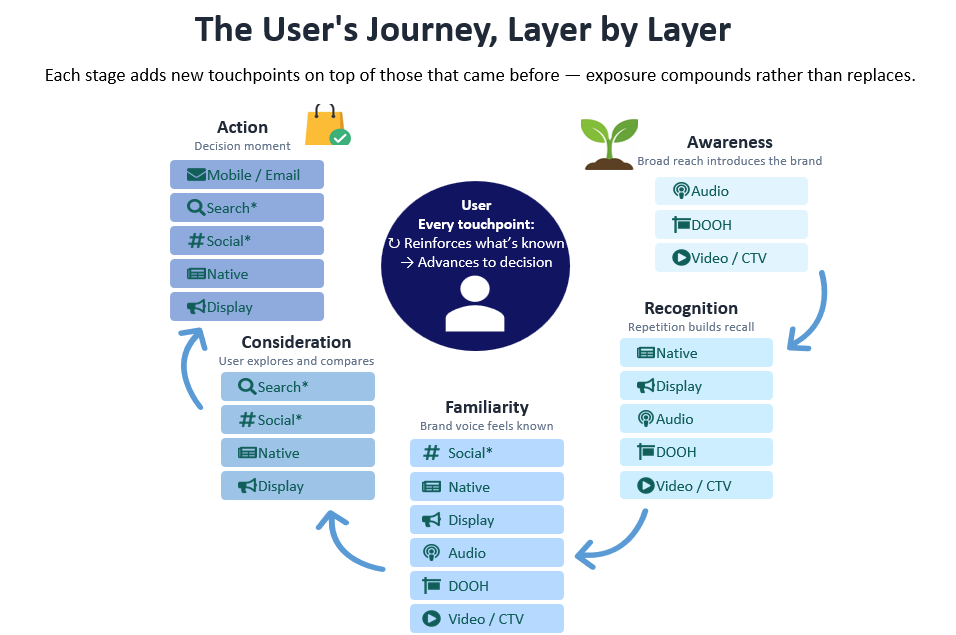
As consumers encounter a brand across different moments and contexts, each exposure contributes to a larger narrative. Awareness leads to familiarity, familiarity leads to consideration, and consideration increases readiness to act.
This is where omni-channel exposure becomes meaningful.
Omni-channel exposure is not about being present on more channels. It is about ensuring that each interaction serves a purpose within the journey—strengthening what the consumer already knows, or guiding them one step closer to decision.
When executed well, this creates a compounding effect. Instead of repeating the same message, each touchpoint adds value, gradually increasing confidence and reducing friction.
The result is not just more conversions, but more efficient and faster conversions—because the consumer has already been guided along the journey before reaching the point of action.
Section 2 – Positioning Programmatic in an Omnichannel, Journey-Based Framework
Programmatic’s role is orchestration, not replacement
Programmatic is often discussed alongside performance channels, but its core value lies in orchestrating exposure across channels and touchpoints, rather than replacing lower-funnel tactics.
2.1 Anchor execution on audience addressability, not isolated channels
A holistic consumer journey starts with who the audience is, not where ads are placed.
Practical execution guidance:
Define the core audience once, then engage that audience differently as it progresses through the journey.
Ensure audience addressability across environments so exposure can be coordinated, sequenced, and measured holistically.
Avoid re‑targeting the same users independently in each channel without visibility across the journey.
Why this matters: Audience‑first planning ensures each touchpoint builds on prior exposure rather than repeating it, reflecting how consumers actually encounter brands over time.
2.2 Design multi‑touch exposure to mirror how consumers evaluate over time
As consumers progress through their journey, repeated exposure across different moments and contexts naturally builds familiarity, relevance, and affinity toward a brand. This reflects how consumers learn, evaluate, and decide — not in a single interaction, but gradually.
Practical execution guidance:
Assign distinct roles to channels based on journey stage (introduce, reinforce, activate).
Use different messages for different stages, ensuring later touchpoints reinforce earlier exposure rather than duplicate it.
Plan for multiple, purposeful interactions rather than expecting a single touch to perform all roles.
2.3 Set journey‑aligned measurement that connects back to conversion
To fairly evaluate multi‑touch strategies, measurement must reflect progression, not just the final action.
Practical KPI framework advertisers can apply:
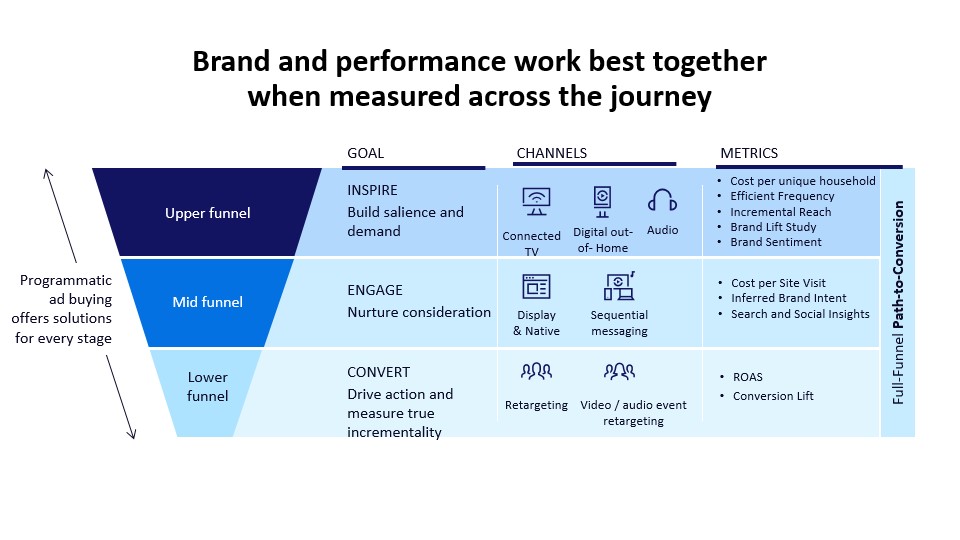
Upper‑funnel KPIs to assess presence and relevance (e.g., awareness, recall, contextual alignment).
Mid‑funnel KPIs to assess persuasion and intent (e.g., engagement, consideration).
Lower‑funnel KPIs to assess action and business outcomes.
Critically, these KPIs should be reviewed together to understand how earlier stages:
increase likelihood of conversion,
shorten time to conversion,
and improve overall efficiency at the lower funnel.
Section 3 – Illustrating These Principles in Action
To bring these principles to life, the following case study demonstrates how an omnichannel, programmatic approach can translate journey-based thinking into real-world execution and measurable business impact.
In Coca-Cola Hong Kong’s campaign, different channels were assigned clear roles aligned with dining moments and occasions, allowing media activation to mirror how consumers experience food and beverage choices in daily life.
Upper-funnel channels such as Uber placements and digital out‑of‑home (DOOH) were used to build awareness in high‑attention, real‑world contexts. By reaching consumers in transit and near dining locations, these touchpoints connected media exposure directly to nearby restaurant options — anchoring the brand to relevant dining moments rather than abstract messaging.
Mid‑funnel activity focused on strengthening consideration through relevance and personalization. Dynamic creative optimization (DCO) allowed messaging to adapt based on cuisine type, dining companions, and dining time, reinforcing the idea of pairing different meals and occasions with Coca‑Cola. This stage deepened contextual relevance rather than pushing immediate action.
Lower‑funnel display activation was then used to drive action, targeting audiences who had already been exposed to earlier touchpoints, as well as users identified through first‑party data from loyalty apps. Having progressed through the funnel and become more familiar with the campaign, these audiences were in a stronger position to respond to promotional messages and visit the site or take action.
Across all stages, overall frequency was managed deliberately, ensuring audiences were not over‑exposed, while still receiving sufficient reinforcement as they moved through the journey.
Crucially, each channel was not evaluated in isolation. Together, the strategy demonstrated how coordinated omnichannel execution can deliver both campaign‑level performance and commercial impact:
Omnichannel exposure drove faster and higher conversions. As consumers progressed through the campaign journey and encountered the brand across different moments and contexts, repeated yet differentiated exposure helped deepen familiarity and relevance. This progression naturally increased readiness to act, resulting in users exposed to multiple channels converted at a significantly higher rate and did so more quickly than those exposed to a single channel.
Upper‑ and mid‑funnel activity delivered measurable brand impact, with notable lifts in ad recall, brand image, and consideration — validating the role of these stages in supporting downstream performance.
The combined strategy translated into tangible business results, with year‑on‑year sales volume growth and market share gains, demonstrating that journey-based execution can drive outcomes beyond short-term metrics.
Lead Associate Account Director The Trade Desk IAB Hong Kong - Programmatic & Measurement Committee Member
Contributor:
Article launched on 29/05/2026
APPENDIX
About the IAB (Hong Kong) The Interactive Advertising Bureau (Hong Kong) empowers the media and marketing industries in Hong Kong, to thrive in the digital economy. It is comprised of more than 150 leading media and technology companies that are responsible for selling, delivering, and optimizing digital campaigns. Working with its member companies, the IAB (Hong Kong) evaluates and recommends standards and practices and fields critical research on interactive advertising.
Please address any questions or comments about this blog to IAB (Hong Kong) Secretariat Office - info@iabhongkong.com